Note: this post is long overdue, as what I thought I had posted to the blog itself ended up being saved as a draft on my phone. As many of my friends would undoubtedly hasten to point out, I am still a bit of a blogging n00b, and I will admit to my fail. On with the post, then:
The mighty, being who they are, have a tendency to fall hard once they have been tripped up. It's not so much that they have a longer distance to fall, but rather more to the fact that gravity seems to have a harder pull on them, so they consequently hit the ground harder.
Feel free to quote me on that: the mighty are not in possession of some high, exalted state compared to the rest of us - it's merely a question of gravitational pull.
Our mighty Fit, it turns out, is something a bit less than the grand two-person chariot that I initially built it up to be. This post was inevitable - if one spends any inordinate amount of time with anything, one begins to find cracks in its armor, blemishes in its complexion, and little annoying character traits that one overlooked or perhaps ignored before. This can happen to anything: jobs, co-workers, electronic gadgets, significant others, hometowns - none are safe from time's unyielding microscope (though in the case of the significant other, one had best learn to live with the imperfections and blemishes if one expects to have peace in the relationship).
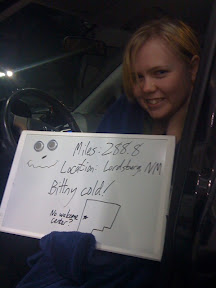
Most recently, we encountered a landform that had been largely absent on our cross-country jaunt: the Rocky Mountains. Traveling east from Phoenix to Texas sends one through the vestiges of this great western range, but the elevation pales in comparison to the sheer magnitude of the grades associated with the trek northeast out of Phoenix. The grades approach 7% in several places, and looking over the edges - while providing majestic views - can be supremely intimidating to anyone with even the slightest touch of vertigo.
It could be said that the Fit suffers from vertigo as well - the mountains are not kind to the little hatchback. I wrote before about the chipmunks under the Fit's hood, and through winding mountain stretches, they are certainly not at home - being from a valley, they are unaccustomed to rapid changes in elevation. They try their hardest to keep the car going, and the engine spins willingly, but the Fit's transmission does it no favors. This gearbox is not optimized for heavy loads of any kind and even minor upward grades cause the car considerable grief. The unfortunate engine/transmission combination is so unsuited for mountain travel that gravity can actually have a stronger pull on the car than all but maximum horsepower: on several graded stretches, I had to maintain an engine speed of around 6200 RPM (where the engine makes maximum power) just to keep from slowing down. Since the engine redlines at 6500 RPM and makes a horrendous racket if it so much as approaches that mark, driving in that manner for extended periods becomes tiresome and worrisome very quickly, as the prospect of grenading the engine on the side of a mountain is less than appealing.
Fuel economy is also severely affected by this kind of driving. On regular streets, the Fit usually turns on the "Low Fuel" light somewhere between 300 & 320 miles. At that point, the car has about 25-30 miles left before reaching absolute empty. On this trip, though, I noticed that the light came on at 260 miles - all the extra time spent at 6000+ RPM had taxed the engine so much that the equivalent of around two extra gallons of gasoline was used just to keep it moving. While other cars would certainly be similarly affected, it would not be quite to the same extent as the diminuitive 1.5L Chipmunk Edition engine in the Fit.
On a related note, as we climbed higher and higher into the mountains, the temperature dropped lower and lower. On the cross-country trip, we both noticed that our side nearest to the door tended to get much colder than the rest of our bodies - sort of a reverse trucker's tan. To test this, I placed a bottle of water in a rear passenger door's cupholder and proceeded through Texas at night. We picked it up that morning and found that it was noticeably colder than other bottles in the car. On one hand, keeping drinks cool for free is a nice bonus - Dodge charges extra for their "Chill Zone" glove box that pipes an extra air conditioning vent into a two-bottle glove box. On the other hand, however, it made temperature control a bit of a pain, as it became a challenge to stay comfortable as the temperature dropped in the dark.
Driving through several states and road types presented us with a litany of street conditions. We dealt with highways and urban streets, parking lots and drive-thrus, back country roads and barren highways, and we realized that while adequate for most situations, the Fit's tires and suspension can come off a bit harsh. The relatively small wheels and surprisingly-firm suspension make for a slightly rough ride under certain conditions and transmit a good amount of road noise into the cabin depending upon the asphalt condition and bumps. In driving the Fit, one can't help but feel that the car is lacking just a bit in substance - though reasonably sporty for its class, the ride makes it feel somewhat stripped down and contentious, as though it isn't quite suited for serious driving.
These little quibbles pale in comparison to the Fit's overall appeal for the way that we use it. Its value for the money is superb where bells and whistles are unnecessary and utility and economy are king and queen. The Fit nails this: it is the very embodiment of the automobile as an appliance with just a hint of fun - much like a refrigerator with a magnetic poetry set. In short, it makes a great city car and a great commuter - one that we will very likely hang on to until it absolutely dies, even. For someone who is used to a bit more comfort, more power, or even that intangible "substance" factor, however, a different vehicle might prove a more pleasant drive. When the driver's needs revolve around utility and economy, however, the Fit's added sportiness is a nice bonus and help make it arguably the best buy in its class.